

Smart Factory
Smart Factory Consulting
Smart Factory Strategy Starts
with a Maturity Assessment
In manufacturing, AI is going beyond improving productivity and driving process innovation to create new business opportunities.
As a result, demand for AI use at manufacturing sites is rising, but many companies are struggling to determine where to start applying AI and in what order to expand its use.
To turn AI adoption into tangible results, it is essential to first accurately assess the factory's current level of maturity and readiness. The following points should be examined at this stage:
- How systematically are production, equipment, and quality data collected and managed?
- How are processes and equipment interconnected, and to what extent are they automated?
- Given the expected benefits of improvement, which processes should be addressed first?
An assessment based on reliable criteria objectively reveals the factory's strengths and areas for improvement.
Opportunities for productivity improvement, cost reduction, and quality improvement begin with an accurate understanding of the factory's current maturity level.
Smart Factory Maturity Self-Assessment, made easy with no on-site visit
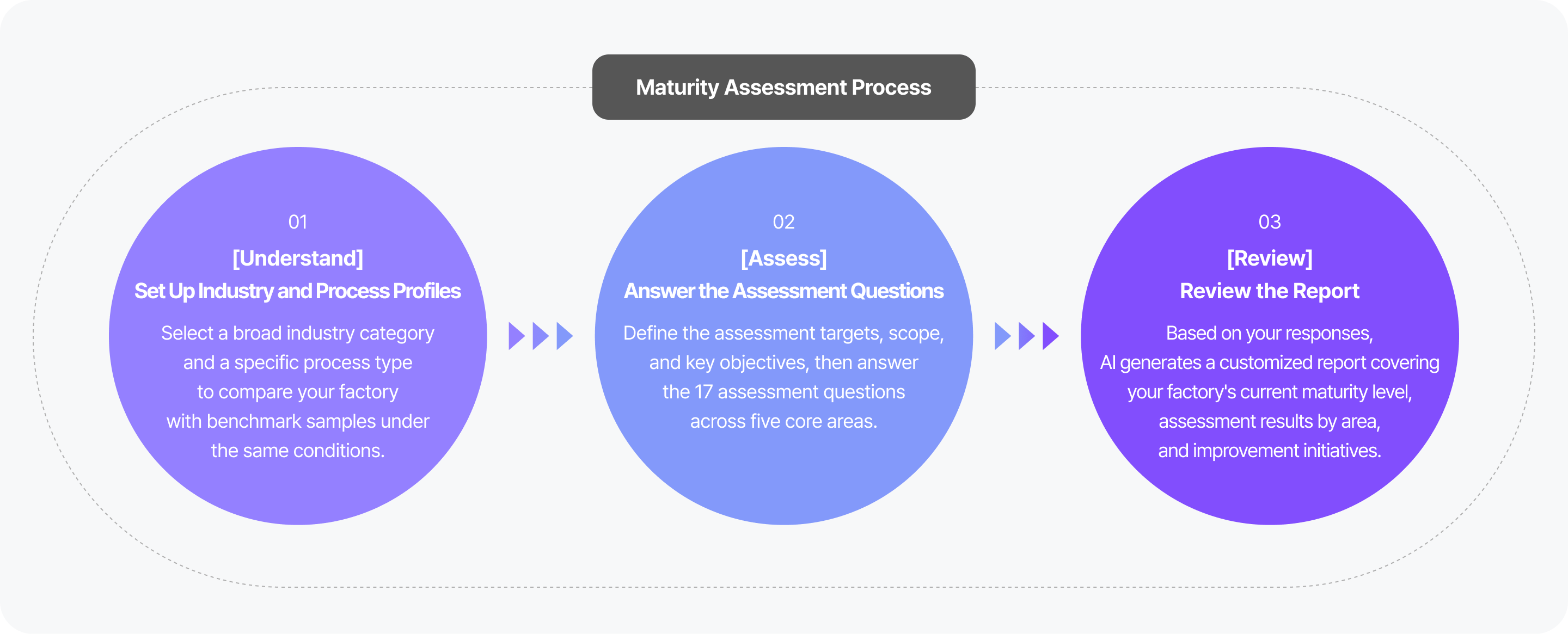
Maturity Self-Assessment Report with Actionable Strategies
Maturity Self-Assessment Report
The Maturity Self-Assessment Report evaluates a company's smart factory maturity based on its assessment responses. Depending on the assessment score, it compares the company with the average of SMEs in the same industry or with leading domestic and global companies, showing its current position, strengths, and priority areas for improvement. Furthermore, the assessment results are linked to an actionable 3-Track Roadmap and LG CNS service offerings, enabling a detailed review of future directions for improvement.
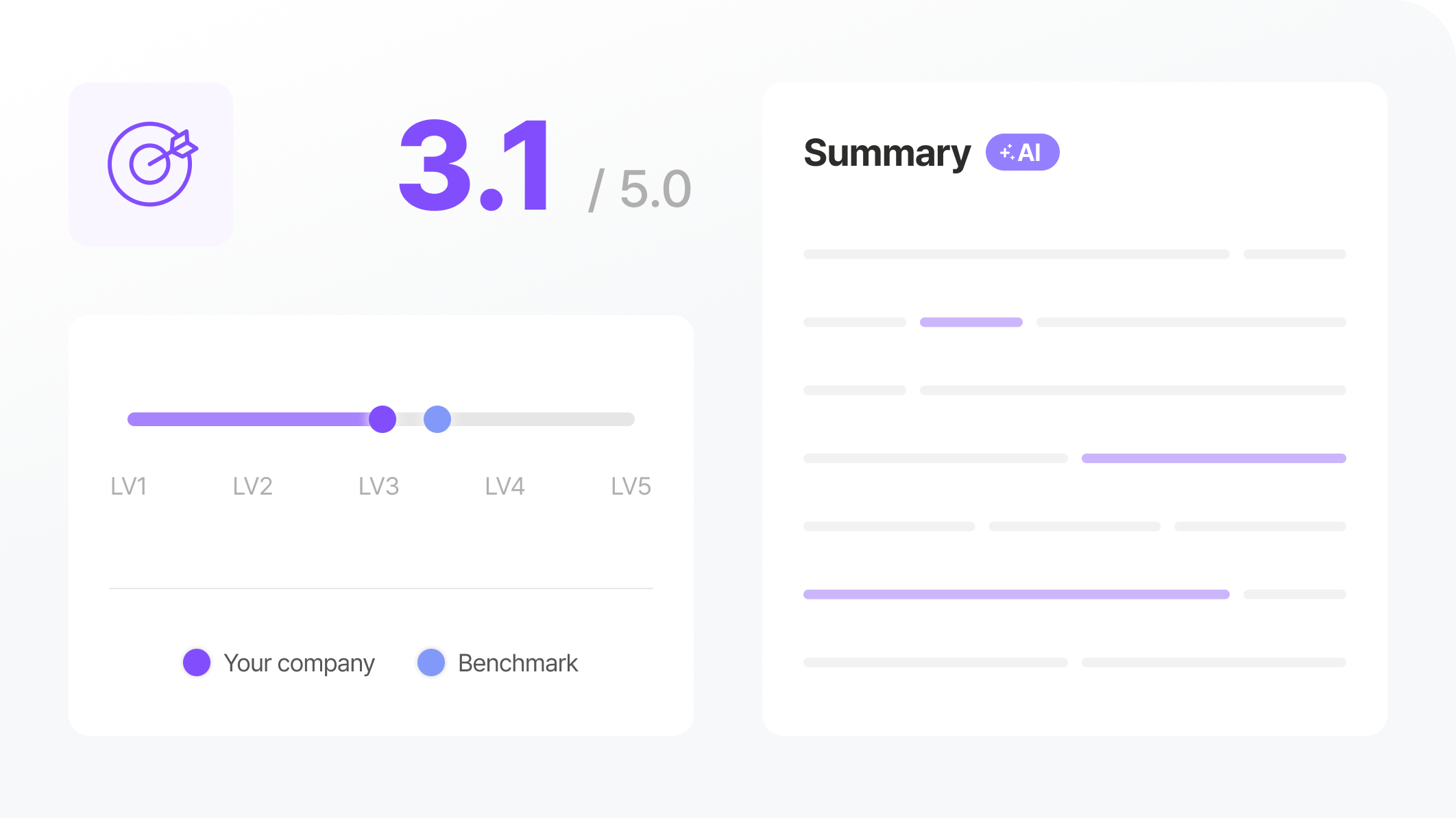
Presents the company-wide relative position based on an overall maturity rating (Levels 1–5), along with an AI-generated summary of key findings on the current status and areas for improvement
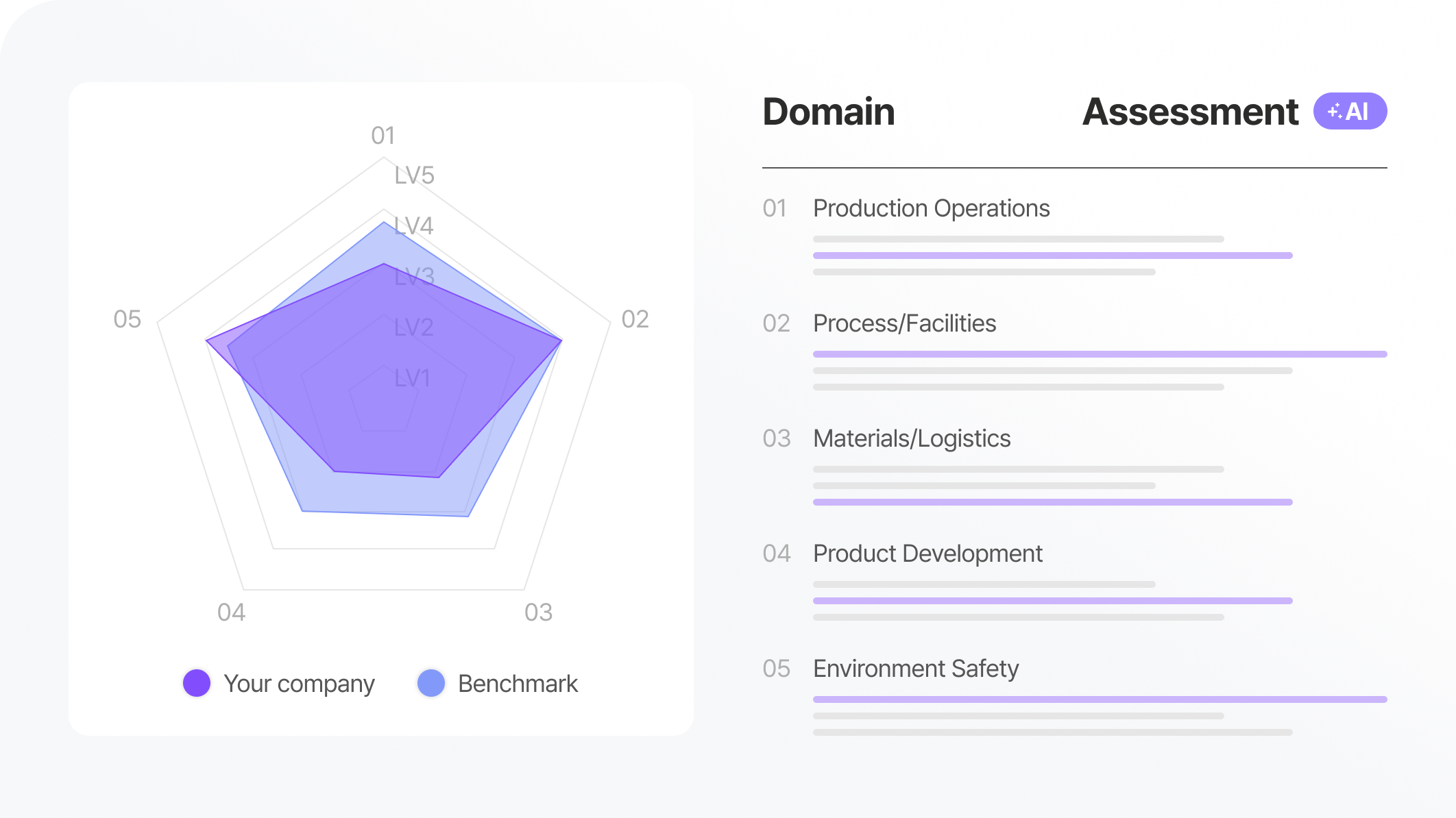
Visualizes maturity by core area and gaps against benchmarks (industry average, leading companies) in a radar chart, and provides assessment results for each area
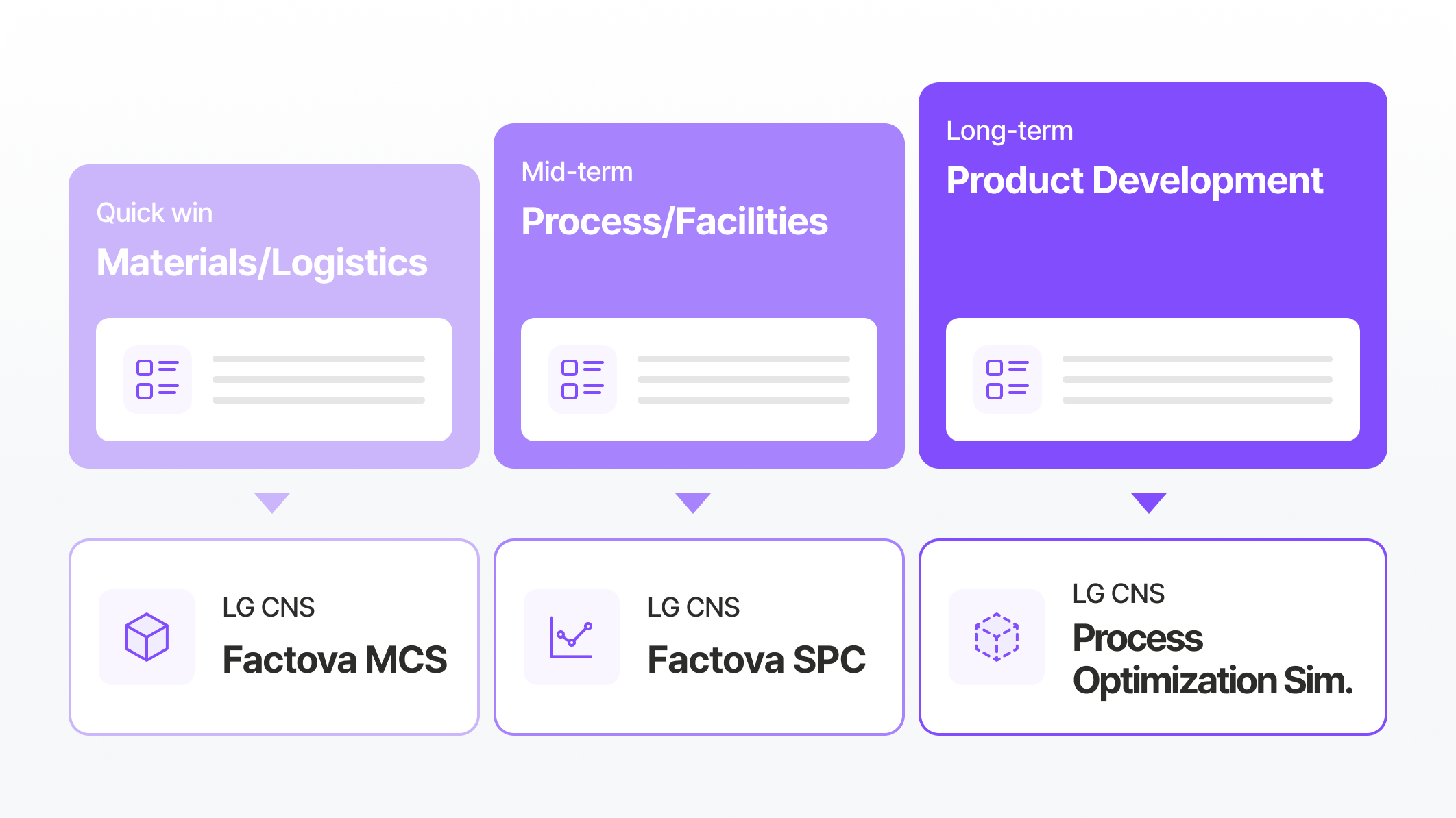
Groups improvement initiatives into three tracks—Quick-Win (short-term results), Mid-term, and Long-term—and proposes implementation directions for each initiative, mapped to LG CNS service offerings
How to Apply for the Smart Factory Maturity Self-Assessment
You can apply for the Smart Factory Maturity Self-Assessment by following these steps:
1. Submit a request for the Smart Factory Maturity Self-Assessment via the LG CNS Service Inquiry page.
2. Please complete the assessment questionnaire sent to the email address you provided when submitting your inquiry.
3. After submitting your responses, you will receive the Maturity Self-Assessment Report via email.
FAQ
-
A. It assesses five areas: production operations, processes/equipment, materials/logistics, product development, and environment/safety. The assessment questions were designed based on LG CNS's experience in building and operating smart factories, and the weighting of each question is adjusted according to the industry and specific process type.
-
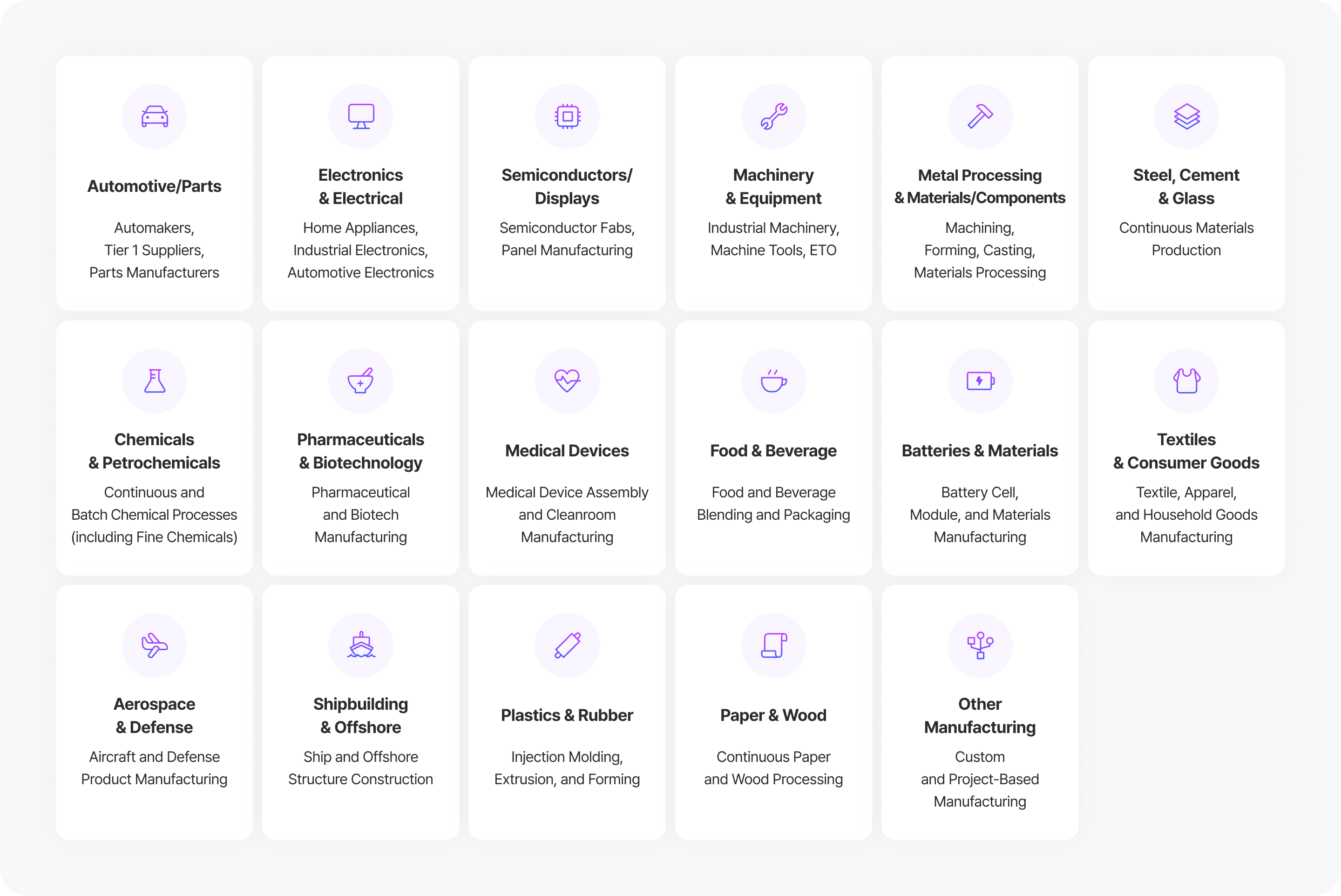
A. Using benchmarks for 17 industry sectors, the results are compared with the benchmark for the same industry and process type. Depending on the assessment score range, the average maturity level of SMEs in the same industry, the maturity level of leading domestic companies, or the maturity level of leading global companies is used as the comparison baseline to show the factory's relative position and gaps in each area.
-
A. The report consists of three main sections. First, the "Company-Wide Smart Factory Maturity Summary" presents the overall maturity level (Levels 1–5) and AI-analyzed key findings on the current status, while "Assessment Results by Area" shows gaps against benchmarks in a radar chart. Finally, the "3-Track Implementation Roadmap" groups improvement initiatives into three tracks—QuickWin (short-term results), Mid-term, and Long-term—and maps them to LG CNS service offerings.
-
A. Yes. The results can lead to Smart Factory Diagnostic Consulting, in which the assessment results are verified on-site together with expert consultants.
Customized On-Site Smart Factory Diagnostic Consulting Service
Qualitative and Quantitative Diagnostics Based on a Standardized Assessment Framework
Smart Factory Diagnostic Consulting is a service in which LG CNS's expert consultants visit the client's site in person to diagnose its smart factory maturity level. It provides a more in-depth diagnosis by reflecting the on-site context and the perspectives of the personnel in charge—aspects that are difficult to fully capture through the online self-assessment alone. Using LG CNS's proprietary standard framework—developed through extensive experience in building and operating smart factories—the service combines on-site interviews with a maturity assessment to present the site's current position and implementation priorities.
Clients can choose between a Rapid Diagnostic and a Comprehensive Diagnostic, depending on their needs.
- Rapid Diagnostic (2–4 days): Focuses on verifying the self-assessment results on-site together with expert consultants.
- Comprehensive Diagnostic (4–6 weeks): Goes further, defining specific improvement goals and directions based on the on-site verification results.
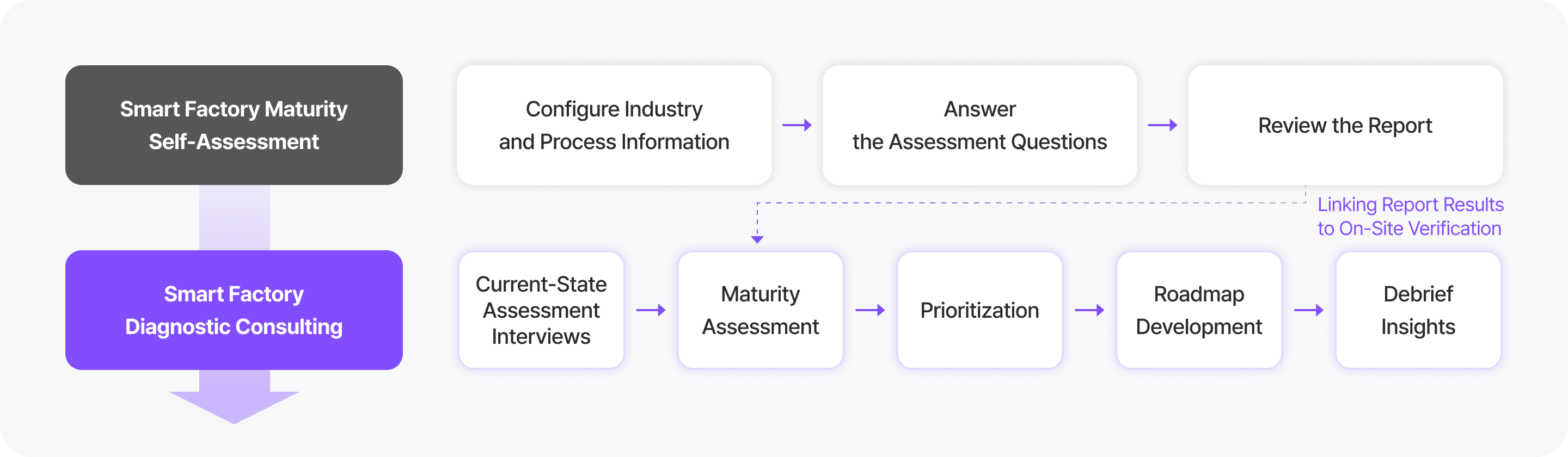
Five-Step Smart Factory Diagnostic Consulting
Smart Factory Diagnostic Consulting proceeds through five steps: current-state assessment interviews, maturity assessment, prioritization, roadmap development, and sharing of diagnostic results.
Expanding Scope of Smart Factory Diagnostics
Smart Factory Diagnostic Consulting centers on Digital Transformation (DX) diagnostics, but the scope can be expanded to include AI Transformation (AX), Robotics Transformation (RX), digital twin, and IT infrastructure, depending on the challenges faced by the site.
-
Assessing digitalization levels across production, quality, and logistics, and identifying the current maturity level of the smart factory
-
Assessing AX Readiness and data readiness, and reviewing AI feasibility and priority areas
-
Identifying high-impact areas for automation and robotics, and reviewing adoption requirements
-
Diagnosing on-site data integration levels, and reviewing digital twin feasibility and prerequisites
-
Assessing the obsolescence and scalability of the factory IT environment, focusing on the foundational requirements for smart factory advancement
How to Apply for Smart Factory Diagnostic Consulting
You can apply for Smart Factory Diagnostic Consulting by following these steps:
1. Submit a request for Smart Factory Diagnostic Consulting via the LG CNS Service Inquiry page.
2. After reviewing your application, an LG CNS sales representative will contact you by phone to confirm the diagnostic target, your key areas of interest, and the requested scope.
3. Based on this consultation, the approach and schedule for the diagnostic consulting are agreed upon before the consulting begins.
FAQ
-
A. It is a service in which LG CNS expert consultants visit the client's site in person to conduct a diagnosis. Unlike the Maturity Self-Assessment, which clients complete online on their own, it verifies the self-assessment results through on-site interviews and inspections and presents a maturity rating from Level 1 to Level 5, along with implementation priorities, based on LG CNS's proprietary standard assessment framework.
-
A. Yes. The diagnosis centers on Digital Transformation (DX), but the scope can be expanded to include AI Transformation (AX), Robotics Transformation (RX), digital twin, and IT infrastructure, depending on the challenges faced by the site.
-
A. It is not strictly required. Diagnostic consulting generally involves verifying the results of a prior self-assessment through on-site interviews and inspections. However, if a self-assessment has not been completed in advance, the assessment can be conducted on-site with expert consultants and consulting can proceed immediately.
-
A. A Rapid Diagnostic takes 2–4 days, and a Comprehensive Diagnostic takes 4–6 weeks. The Rapid Diagnostic focuses on verifying the self-assessment results on-site together with expert consultants, while the Comprehensive Diagnostic goes further, defining specific improvement goals and directions based on the verification results.
-
A. In addition to the on-site verification of the Rapid Diagnostic, the Comprehensive Diagnostic also provides case studies from similar industries, target KPI levels, implementation costs and schedule, and a target system architecture diagram.. This allows clients to compare their site's maturity level and directions for improvement with those of industry peers and review the implementation plan in detail.
-
A. It proceeds through five steps: current-state assessment interviews, smart factory maturity assessment, prioritization, roadmap development, and sharing of diagnostic results and insights. In the final step, a debriefing is conducted based on the final report summarizing the diagnostic results, sharing insights on key focus areas and applicable solutions.