IMPACT STORIES
Impact Stories
Explore LG CNS smart factory impact stories by industry, region, and solution.
← Impact Stories
 /Factova Control
/Factova MES+/Factova RMS/Factova AI Vision/Factova SPC·FDC
Industrial robot manufacturer · Korea
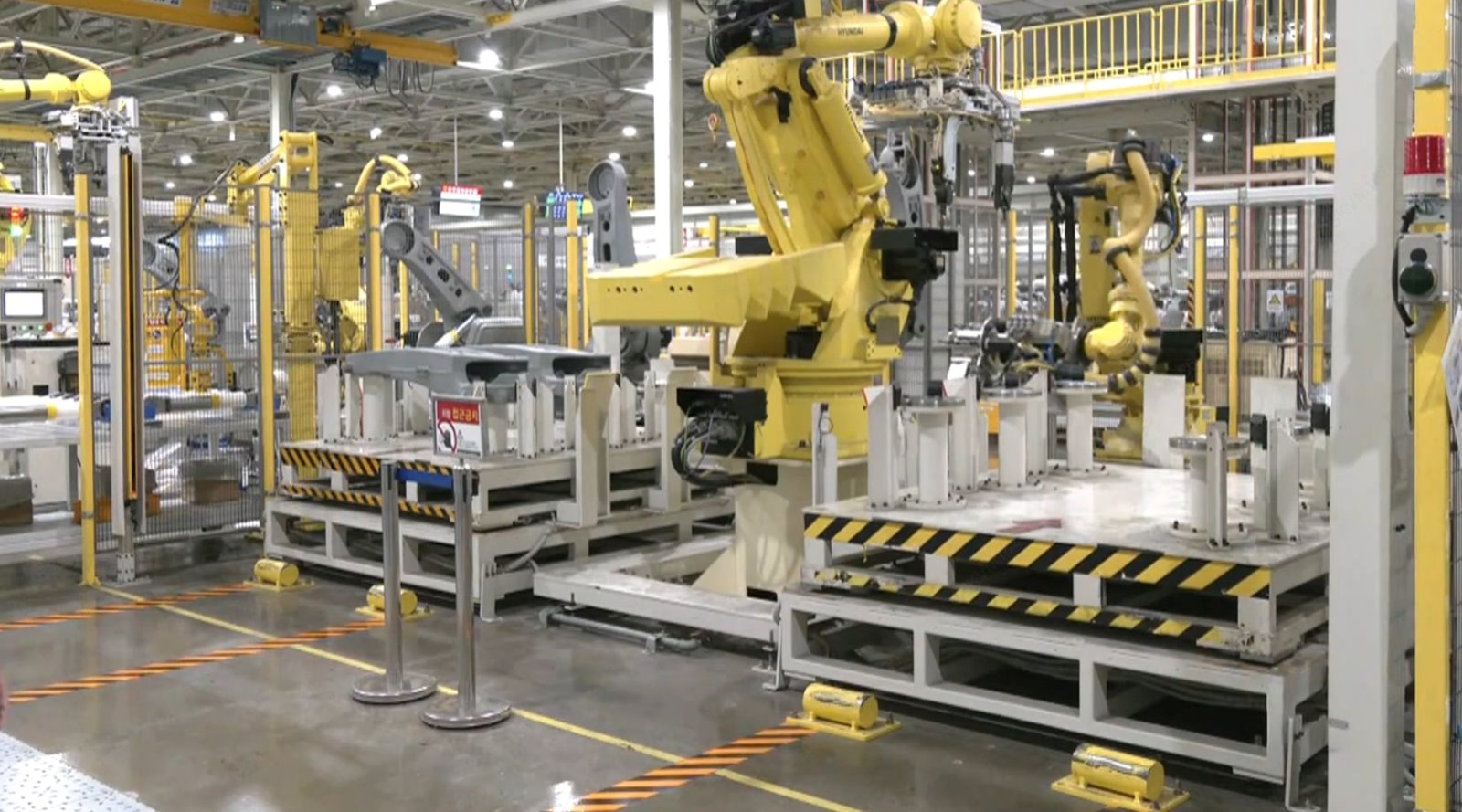
Industrial robot factory, automation rate from 23% to 54%
A phased roadmap designed to combine process and logistics automation with smart factory informatization (DX)
Factory automation rate (design target)23% → 54%Engineering design target · not a result of construction
/Factova ControlChallenge
- To meet growing market demand and mid- to long-term business expansion, production capacity had to be increased within regular working hours
- With factory automation at about 23%, additional labor hours keep accruing as output grows
- Due to limited warehouse space, about 40% of factory floor area is used to store materials and semi-finished goods
- Supplier materials and modules and controller-related issues account for about 70% of supplier NCRs
Smart Factory Execution Plan
- Process automation: eliminating manual processes and expanding automated equipment: converting the manual final assembly conveyor to AMRs, adopting an Auto Tool Changer and robotic automatic assembly for small-batch, high-mix assembly, and introducing an automatic painting transfer machine
- Logistics automation based on an automated warehouse: automated warehouses for materials, controllers, and semi-finished goods plus 5 types of AMRs automate in-process and inter-process transfer and loading, applying 119 automated transfer zones (82%) and 133 automated input ports (62%), with logistics containers standardized
- Core component production automation (in-sourcing) — upper-arm assembly and controller production automation, with Vision inspection and automated EOL testing
- Smart factory digitalization (DX) — 10 initiatives including SCM PI, MES, EIF, WMS, MCS, APS, MRP and QMS, plus a To-Be system architecture, targeting system-based production operations at Level 3 (standard- and rule-based automatic control)
- Phased rollout — 2027: logistics automation and real-time shop-floor data collection → 2028: expanded process automation and digitalization of core operations → 2029: complete production automation and system-based operations → 2030 and beyond: continuous improvement
Design Targets
- Factory automation rate 23% → 54% (2029), targeting 62% with continuous improvement
- Logistics automation rate 17% → 63% — logistics headcount does not grow even as volume, item variety and logistics complexity increase
- Plan-to-execution linkage, real-time shop-floor visibility, inventory accuracy and quality traceability
- Integrating equipment, production, quality and commissioning data to lay the foundation for future AI analytics, predictive maintenance and autonomous operations
Robot Assembly Automation Cell
Robot Assembly Line
23% → 54%Factory automation rate (design target)
17% → 63%Logistics Automation Rate (Design Target)
119 (82%)Automated Transfer Sections (Design)
10Digitalization Initiatives (Production Operations Level 3)
The figures above are design-stage targets from LG CNS engineering, not implementation results.
Service Offerings:
Factova MESFactova RMSFactova RTDFactova RTSFactova ControlFactova MCSFactova CIM+
You may also be interested in
/Factova MES+Global battery manufacturer · North AmericaStabilizing yield at a new factory, from 12 months to 1 month
/Factova RMSGlobal electronic components manufacturer · KoreaA future-mobility parts hub built on standardized recipes
/Factova AI VisionGlobal display manufacturer · KoreaEnd-to-end traceability with digital lot management
/Factova SPC·FDCDefense & aerospace manufacturer · KoreaTurning a hazardous-materials plant into an unmanned factory